Weekly Roundup: Arrivals Lag, Maritime Laws Land, Youth Fundraiser Gains Steam

Executive Summary

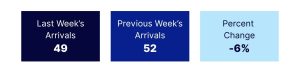
Vessel activity dipped last week across Washington ports — a concerning trend given the ongoing cruise season. Overall arrivals dropped from 52 to 49, continuing a downward trajectory when our seasonal average should be topping 60.

Notable Changes:
  • Tanker arrivals rose +29% (from 7 to 9)
  • General cargo fell to 0 (from 2)
  • Container ships dipped slightly (–6%)
  • Passenger traffic held steady at 13 vessels

Operations & Technology

  • New Data Access Tool: We’ve signed a contract to build an API for real-time watch floor data. Once live, members will be able to integrate live traffic insights into their own operational platforms.
  • AIS Network Status: All 7 receiver towers are fully operational with 100% uptime this week.

Policy & Legislative Update

New maritime laws take effect on July 27, 2025, with implications for ferry staffing, paid leave, and youth maritime training:

  • HB 1167 – Expands maritime education
  • SB 5191 – Enacts paid family leave coverage for dockworkers
  • HB 1511 – Ferry captain salary updates
  • SB 5794 – Big win for Washington Maritime because we successfully pursued WA legislation: Tax rollback goes into effect Jan 1, 2026
  • SB 5281 – A pro-tourism vessel permit, easing nonresident vessel rule (effective Sept 1, 2025)

Spotlight: Global Trade Fog, Local Impact

The Trump-era spike to 145% tariffs on Chinese imports—now eased to a much hyped yet still-punishing 55% total average (without clear or transparent agreements established yet) —has contributed to perpetual market confusion that we’ve yet to fully work out. It’s very hard to say what the long-term trend is for us in PacNW, but overall it’s not looking good for the remaining 2025 and early 2026 ship count.

Ships are still arriving in the US but with less cargo onboard, yet ocean carrier bookings are at near full capacity. What a paradox of the market (!), right? yet it sort of makes sense in that we still need to move cargo that meets economic muster, so there’s got to be an expense ratio that is still profitable.


Scholarship Success – Thank You!

What a day! Our first annual John Veentjer Youth Maritime Scholarship Fundraiser Cruise aboard the Virginia V was a huge success — raising nearly $10,000 to support young people pursuing maritime careers.

It was an incredible day on the water, with sunshine, good company, and powerful stories. Chloe, a graduate of the inaugural Maritime High school class and future mariner, shared her journey and plans to attend Cal Maritime this fall. Many attendees shared memories of the Virginia V — and for many like us, it was their first time taking her out on a cruise.

If you were not able to make it, there’s still time to support the fund. We’ll continue fundraising through the year, with scholarships awarded in May 2026 in partnership with YMTA. Donate here to help us keep the momentum going and support the next generation of maritime professionals.

Weekly Roundup: Succession, Sanity, and Staying the Course

Vessel Traffic: Holding Steady, Trending Up

We recorded a 22% increase in overall commercial vessel arrivals this week, driven by bulk and container ships. That’s a healthy sign of activity, even as other indicators flash yellow.

Total Arrivals: 43 → 55
Notable gains:

  • Bulk: +64%

  • Containers: +29%

  • General cargo: +200%

Berth Arrivals: 47 → 59 (up 20%)

  • Seattle up 24%, March Point up 43%, Aberdeen and Anacortes back online

  • Port Angeles: 0 arrivals

Operations Snapshot

  • We continue to experience radio outages at Ellis Tower and are evaluating rerouting options.

  • Met with the incoming Coast Guard Sector Puget Sound Prevention Department Head to strengthen future collaboration.


Legislative Update: No Major Shifts This Week

Most priority bills have passed and are now awaiting effective dates. A few remain in review, and we’re watching closely for signs of a special session to finalize the state budget.

Bills Passed & Awaiting Implementation:

  • HB 1167 – Maritime education in career & technical programs (Effective 7/27)

  • SB 5281 – Nonresident vessel permits (Effective 9/1)

  • SB 5191 – Paid family leave for dockworkers

  • SB 5161 – 2025–27 transportation appropriations

  • HB 1511 – Ferry captain authority clarified (Effective 7/27)

  • HB 1414 – Student career access (Effective 7/27)

  • HB 1264 – Ferry system salaries

  • SB 5794 – Tax preference repeal (Marine Exchange opposes)

Bills We’re Monitoring:

  • SB 5160 / HB 1226 – Supplemental transportation budget

  • SB 5550 / HB 1324 – CCA-funded transportation investment

Under Review:

  • SB 5652 – Environmental equity in port communities

  • SB 5519 / HB 1652 – Low sulfur marine fuel standards

  • HB 1684, HB 1513, HB 1678 – Coastal, conservation, and infrastructure bills

Didn’t Advance:

  • SB 5248 – Bridge collision prevention

  • HB 1689 – Emissions at berth

  • HB 1288 – Outdoor rec & climate adaptation

Spotlight: Where Are All the Mariners?

We’ve got a succession crisis in maritime—and it’s not hypothetical. Pilots are aging out. Engineers are retiring. Tug captains and dispatchers are slowly slipping out of the workforce. And there’s no wave of new talent waiting in the wings.

At a recent Olympic Coast National Marine Sanctuary meeting, someone mentioned they couldn’t find a line handler for their research vessel. That’s not a blip—that’s a system strain.

If we don’t bring in the next generation, there will be:

  • No ships

  • No terminals

  • No ferries

  • No working waterfront

This industry gave me everything. A mission. A living. A life. And now, it’s our job to ensure someone else gets that same shot.

Help Us Build the Next Generation

We launched the John Veentjer Maritime Scholarship to break down barriers and open doors. These are unrestricted scholarships—fast, flexible, and designed to put money on target with as few speed bumps as possible.

We’re hosting a fundraiser cruise on June 12 aboard the Virginia V. Can’t attend? No problem. Just donate. It matters.

👉 DONATE OR JOIN US

Upcoming Events – Week of May 19

  • Monday – PNWER Cross-Border Supply Chain Workshop (Bellingham)

  • Tuesday – Puget Sound Marine Firefighting Commission (online)

  • Wednesday – ECHO Vessel Operators Committee

  • Thursday – Marine Insurance Association of Seattle: Day of Education

Final Word: Tariff Who? Tariff What?

The Trump Administration called for a 90-day tariff pause on Chinese imports—and the markets barely blinked. That tells you everything.

This isn’t trade strategy. It’s policy whiplash dressed up in populist cosplay. And once again, the people getting punished are port communities like ours—workers, exporters, logistics firms, and mariners.

If it feels like nobody wants to talk about this, but everyone is talking about it—you’re not imagining things.

The tide is shifting. Let’s keep our heads above water—and bring the next crew aboard while we still can.

April in Review: Steady Through the Storm

I’m exhausted by what’s happening in this little/big world. If it didn’t impact thousands of people, I could just go back to my garden.

But – no, here we are. So many things I can’t control but trying like hell.

April 2025 closed with 186 commercial vessel arrivals across Puget Sound and Grays Harbor — a modest monthly total, but one carrying deeper meaning.

Container traffic held its position at 58 arrivals, while tanker and bulk movements reflected slight softening. The return of cruise ships — 13 in total — added seasonal energy to Seattle’s waterfront. Tacoma led all ports with 78 arrivals, driven by RO/RO and container throughput. Seattle followed with 58, supported by a mix of container, bulk, and passenger traffic.

Foreign arrivals remained steady at 118. Japan, South Korea, Canada, and China were the region’s top overseas trading partners — a reminder that despite rising protectionist rhetoric, our ports remain global in purpose.

While vessel traffic ticked down 11% last week, the Marine Exchange continues to provide up-to-the-minute maritime intelligence to help our partners plan, coordinate, and adapt.

Legislative Wrap-up

Several key maritime bills were signed or delivered to the Governor:

  • HB 1167 (Maritime CTE education) – Supported

  • HB 1264 (Ferry salary support) – Supported

  • SB 5281 (Nonresident vessel permit access) – Supported

  • SB 5794 (Stevedore tax hike) – Opposed, but passed. This is a big deal because we fought hard to get the stevedore provision stripped from this.

Looking Ahead

With geopolitical tensions rising and tariff risks expanding, we’re forecasting a potential 40% reduction in import volume over the coming months. The threat isn’t just policy — it’s uncertainty. As your regional watch center, we’re focused on clarity and continuity.

Join Us

Fundraiser Cruise – JV Maritime Scholarship.
📅 May 8 – Coast Guard Foundation Dinner
📅 May 9 – Propeller Club Maritime Day Breakfast (Gold Sponsor)

Weekly Roundup: Strong Vessel Traffic, Legislative Wins, and Navigating Uncertain Waters

This week brought a welcome boost to vessel activity across Puget Sound, along with some important progress on the legislative front. As spring weather delivered record-breaking warmth, the Marine Exchange stayed busy supporting ship arrivals, hosting industry partners, and advancing critical maritime policy work. Here’s a closer look at what happened this week:

Vessel Traffic Surges 27%

Vessel arrivals jumped significantly, with a 27% increase compared to last week. Container traffic rose 29%, vehicle carriers surged 78%, and tanker arrivals grew by 22%. Passenger traffic also picked up as cruise season edges closer, recording a 67% rise in vessel counts.

Seattle and Tacoma continued to anchor the region’s activity, each seeing double-digit increases in port arrivals. March Point also saw a 43% boost, reinforcing the importance of our fuel supply chain hubs.

It’s an encouraging sign that Puget Sound remains an essential gateway, even as global shipping markets wrestle with rising uncertainty.

Scholarship Fundraiser: Cruise Aboard the Virginia V

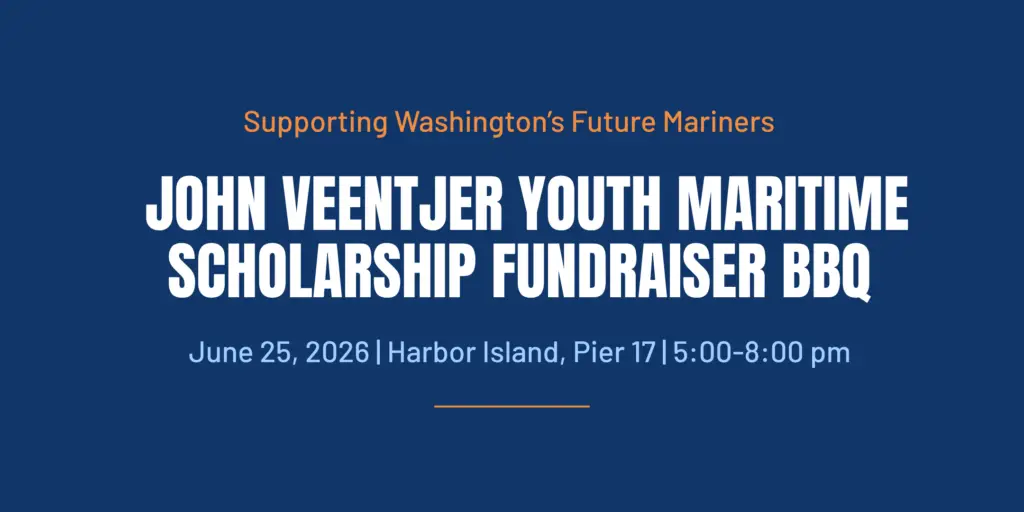
We’re thrilled to announce the launch of the JV Maritime Scholarship Fundraiser Cruise, happening June 12th aboard the historic Virginia V on Lake Union.

This event supports maritime career pathways for the next generation. Come enjoy an evening on the water and help us invest in the future of our industry! Learn more and register here.

Community Connections: Society of Naval Architects & Marine Engineers (SNAME)

This week, we hosted members of SNAME for an information exchange and networking event. The Marine Exchange is proud to foster collaboration across disciplines, bringing together operational expertise, engineering innovation, and academic leadership to strengthen the maritime sector.

Legislative Update: Wins for Washington’s Maritime Future

This week delivered several key victories in Olympia:

  • SB 5794: Major opposition success — harmful tax provisions removed before passage.

  • HB 1264: Delivered to the Governor — supporting collective bargaining for ferry workers.

  • Career and Maritime Education Bills: Creating new pathways into maritime jobs — both bills heading to the Governor’s desk.

  • Vessel Permit Modernization and Paid Family Leave for Dockworkers: Progressing with strong bipartisan support.

These outcomes reflect months of advocacy and coalition-building. We’ll continue tracking remaining bills as the session closes.

Technology & Data: AIS and Cloud Modernization

All 7 of our AIS receiver towers remain fully operational with 99.9%+ uptime. Work continues to migrate our ship database to a new cloud platform — setting the stage for more advanced API connections, automated backups, and greater system resilience.

We’re still awaiting a hardware repair at Ellis, but no major disruptions have been noted.

Spotlight of the Week: Red Light/Green Light on Trade

Global trade is flashing warning signals. Between new tariff threats, rising gold prices, currency volatility, and skyrocketing national debt, the economic backdrop feels increasingly unstable. Goldman Sachs just doubled its probability estimate for a U.S. recession in the next year.

While it’s too early to predict exactly how this will hit Washington’s ports, we’re closely watching indicators like:

  • Rising blank sailings (canceled voyages)

  • Increased abandoned cargo rates

  • Shifts in job reports and inflation rates

The Marine Exchange will stay vigilant, providing real-time insights and operational support as conditions evolve.


Thanks for staying connected with the Marine Exchange. We’re proud to serve the Puget Sound maritime community, ensuring safe, efficient, and resilient operations — no matter what waters we find ourselves navigating.

If you haven’t yet, don’t forget to reserve your spot for the Virginia V Scholarship Cruise!

Weekly Roundup: Legislative Moves, Stormy Skies, and a Push for Clarity

By Patrick Gallagher, Executive Director, Marine Exchange of Puget Sound

Each week, I share a briefing that summarizes maritime trends, port operations, and relevant policy developments shaping our region. Here’s what moved the needle this week across the Puget Sound maritime landscape.


Legislative Push: All Eyes on SB 5794

I made two trips to Olympia this week, both centered around Senate Bill 5794, which we oppose. On Tuesday, I attended a policy briefing on the bill. The next day, I returned to interview Representatives Greg Nance and Julia Reed for our upcoming Maritime Morning Brief podcast episode.

SB 5794 is framed as an effort to clean up the tax code, but it poses real risk to maritime logistics and workforce incentives. I’ve committed to testify in opposition this coming Monday during the Senate Ways & Means Committee hearing at 4:00 PM.

This is a Priority 1 issue for the Marine Exchange and one we believe deserves full industry attention.


From Rain to Tornadoes: Situational Awareness

Western Washington weather made headlines this week with lightning, heavy rains, and even a tornado warning—a rarity in our region. While we experienced several days of limited visibility, there were no major disruptions to vessel traffic or port operations.


Maritime Operations & Collaboration

  • We are distributing the Intent to Participate for this summer’s ECHO Program slowdown to help protect Southern Resident killer whales. The Marine Exchange has supported the ECHO slowdown since its inception.
  • We continued preparations for the Coast Guard Foundation Dinner in Seattle.
  • I joined a fundraiser for Port of Seattle Commission President Toshiko Hasegawa, reinforcing our commitment to local leadership and maritime governance.
  • Next week, we’ll meet with Washington Sea Grant to begin discussions on marine traffic lane planning—a proactive step toward improving safety and environmental balance in our waters.

Technology Snapshot

  • Our AIS network remains rock solid, with >99.9% uptime across all seven towers.
  • Cybersecurity status: no anomalies detected.
  • Our database optimization project remains underway, with progress aligning with planned upgrades to our internal data systems.

Legislative Scorecard: March 28 Update

Alongside SB 5794, the Marine Exchange is actively tracking and weighing in on more than two dozen bills. A few highlights:

  • HB 1167 (Maritime CTE): Passed the House 96–0–2, now awaiting Senate action.
  • SB 5191 (Dockworker Paid Leave): Cleared the Senate and is now in House Appropriations.
  • HB 1511 / SB 5059 (Washington State Ferries Captains): Strongly supported and moving.
  • SB 5281 (Nonresident Vessel Permits): Passed the Senate unanimously; now in House.

Final Word: why we pay attention

I don’t know why exactly, but this beautiful industry in this beautiful place is taking hits from every level. Washington maritime gave me everything, so I can’t NOT protect what I love.

You may have noticed a much more aggressive stance from the Marine Exchange lately, but that’s commensurate with the amount of urgent threats that we’re facing. Trump tariffs, USTR Chinese ship fees, Seattle City Council vote to rezone industrial land, proposed legislation to impost CARB rules, “paused” EPA ports grants, reduction of NOAA personnel and capability, threatened FEMA support and paused Port Security grants all add up to an accumulation of impact that we cannot measure.

We’re paying attention because we deeply care about the fate of an industry that has given so much to so many.


Stay tuned for next week’s update, which will include results from my Olympia testimony, a recap of our WA Sea Grant meeting, and new developments around regional AIS data sharing.

If you have questions, ideas, or want to subscribe to this roundup directly, contact us here.


Patrick Gallagher
Executive Director
Marine Exchange of Puget Sound

Help Us Oppose SB 5794 – Protect Washington’s Maritime Industry & Jobs

Dear Members and Maritime Community,

I am reaching out to you with rapidly growing concern about proposed legislation that could dramatically alter the cost and competitiveness of doing business in Washington’s maritime sector.

Senate Bill 5794 (SB 5794) proposes to eliminate the Public Utility Tax (PUT) exemption for cargo movement and repeal the Business & Occupation (B&O) preferential tax rate for stevedoring and freight services. These are not loopholes—they are time-tested, well-vetted tax policies that have helped Washington remain a global gateway for trade, logistics, and jobs for nearly 100 years.

If passed, this bill would increase costs across every link of the supply chain, reduce our port competitiveness, and threaten jobs—not just within maritime, but across agriculture, manufacturing, and export-reliant industries.

WHAT THIS MEANS FOR WASHINGTON

  1. Prices will increase for everyone.
    Cargo doesn’t just disappear—it reroutes or becomes more expensive. Taxing the movement of goods on ships, trucks, and trains within Washington creates a “tax pyramid”—where costs multiply with every link in the chain, impacting businesses and consumers alike.
  2. Jobs will be lost.
    Washington’s maritime and logistics sectors support thousands of family-wage jobs. A disproportionate share of these jobs are held by workers of color (34% compared to 23% of the state’s population), meaning these changes will also exacerbate inequity.
  3. Washington will fall behind.
    Other states and provinces are doing the opposite. British Columbia, South Carolina, Georgia, Louisiana, Virginia, and others offer tax incentives to attract cargo and grow jobs. SB 5794 would make Washington an outlier—for all the wrong reasons.
  4. Cargo will be diverted.
    Much of the cargo moving through our ports is discretionary and bound for destinations beyond Washington. If operating costs climb, shippers can easily divert this cargo to ports in Canada, California, or along the Gulf Coast.
  5. Washington exporters will lose access to containers.
    Exporters depend on imported cargo for vessels and empty containers needed for outbound shipments. If imports are driven away by higher costs, exporters—including small farms, food processors, and manufacturers—lose access to the very infrastructure they rely on.

TAX PREFERENCES ARE NOT OBSOLETE

JLARC, the Legislature’s own audit agency, recommended clarifying the objectives of these tax preferences—not eliminating them. In 2012, they voted to maintain the preferential B&O rate for stevedoring, calling it a tool for increasing port competitiveness.
Numerous public and academic studies, including from the Federal Maritime Commission and the Joint Transportation Committee, confirm the price sensitivity of Washington cargo. Tariffs and trade disruptions have already harmed Washington ports—tax increases will only compound the problem.

WHAT YOU CAN DO

  1. Sign on to the Opposition Letter
    We are organizing a joint letter of opposition to SB 5794. We invite your organization to add its name and stand with Washington’s maritime workers, exporters, and businesses. To sign on, please contact Patrick Gallagher at patrick@marexps.com as soon as possible. You can also register to testify online here.
  2. Call Your Senators – Today
    Tell your State Senator that you oppose SB 5794 and urge them to support maritime jobs and economic competitiveness. Contact your legislators here. Use this sample message when you call: “I’m calling to oppose SB 5794. Repealing maritime tax preferences will drive cargo away from Washington ports, raise prices, harm exporters, and put thousands of jobs at risk. Please protect Washington’s global trade competitiveness and vote no on SB 5794.”
  3. Spread the Word
    Share this message with your networks, port partners, trade organizations, and regional stakeholders. The more unified our voice, the stronger our case.

Washington’s maritime economy is a pillar of our state’s identity and prosperity. These tax preferences have worked for nearly a century—keeping our ports competitive, our exports flowing, and our communities employed. Now is not the time to undo that progress.
Thank you for your continued support and commitment to protecting the future of maritime trade in Washington.

Sincerely,

Patrick Gallagher
Marine Exchange of Puget Sound, Executive Director

Port Pulse: March 21, 2025 — Maritime Insights from the Watch Floor to the Capitol

lighthouse in fog

In a session shaped by fog on the water and foggier politics in Olympia, the Marine Exchange remains steady on course — committed to clarity, coordination, and context. Friends, there is A LOT happening including Seattle City Council voting 6-3 against the maritime industry and the preservation of industrial lands. Also, the Puyallup Tribe announced an agreement with the NW Seaport Alliance to develop a new terminal. This is great news that we needed.

As spring arrives in Puget Sound, so too does a changing tide in vessel traffic, port dynamics, and legislative strategy. This week’s snapshot offers insight into what’s happening on the water, in Olympia, and behind the screens of our AIS network. Here’s what stood out:

Summary

Vessel arrivals declined 27% from last week, driven primarily by a sharp drop in bulk carriers. Although bulkers display seasonal trends, this remains outside what we’d normally see, and I’m just not sure exactly what is happening in this category.

AIS network operations continue to exceed expectations, and we’re making enhancements to both our hardware (removing one piece in the chain) and software. On the policy front, budget issues now dominate Olympia, but maritime bills are still making meaningful progress.

National news for the maritime industry remains sour and uncertain. The Federal Reserve kept rates flat which stoked fears of stagflation. If you remember your Econ 101, stagflation is the worst of all worlds heralding suppressed growth and elevated unemployment. This is an economic condition that is very difficult to overcome and generally considered worse than recession.

Situational Awareness

  • Weather Impacts: Fog persisted early in the week, causing minor pilot boarding delays at Cape Flattery and within VTS Puget Sound.
  • Disruptions: None reported. A quiet week operationally.
  • Tariffs and Trade: Although new USTR fees on Chinese-flagged ships are anticipated, it hasn’t been long enough to properly gauge impacts to Washinton maritime.

Maritime Operations and Coordination

  • VTS Continuity Planning: We participated in discussions with USCG Sector Puget Sound to explore backup capabilities using our watch floor.
  • Pilotage Software Integration: Continued collaboration around Portlink and dynamic routing data.
  • NOAA Sanctuary Contract: Monitoring project is temporarily delayed due to federal budget uncertainties.
  • Podcast Guest Update: Sara told me not to tell! We have 3 new guests lined up, and we’re really stoked to bring them on the Maritime Morning Brief. Stay tuned!!

Technology and Data

  • AIS Network: All 7 towers fully operational with >99.9% uptime.
  • Platform Optimization: Database improvements underway to enhance query speeds and reduce storage load. If you receive any of our reports, you won’t notice anything different – it’s sort of like doing foundation work on your house when what you really want to do is paint the living room.
  • Cybersecurity: No threats or anomalies detected this week.

Legislative Insights: Maritime Still Afloat Amid Budget Storm

After a frenzied House of Origin cutoff week, Olympia has entered a more measured pace. The House passed over 1,000 bills to the Senate; the Senate returned just 250. This gives Senate bills a fighting chance in House committees spread across 20+ policy areas.

However, the newly released state budget forecast casts a long shadow: a $17 billion shortfall means painful cuts and potential new taxes are likely. Many bills will quietly die as attention shifts to balancing the books.

That said, 5 of the 7 bills supported by the Marine Exchange of Puget Sound are still alive:

  • SB 5191: Dockworker paid leave – executive session scheduled in House Labor Committee.
  • HB 1167: Maritime career education – advanced in Senate committee.
  • HB 1414: Broader access to CTE – heard 3/19.
  • HB 1264: Ferry collective bargaining – heard 3/17.
  • SB 5281: Nonresident vessel permit reform – heard 3/13.

Two bills we supported are likely dead:

  • SB 5059 (Washington State Ferries captains): Moved to Senate Rules “X” file.
  • SB 5248 (Bridge collision working group): Missed cutoff.

And one we opposed — HB 1689, targeting unrealistic berth emissions standards — is officially dead for now.

We’re watching the April 2 policy committee cutoff and April 8 fiscal committee cutoff. Bills marked “Necessary to Implement the Budget” (NTIB) can still survive, even if deadlines pass.


Spotlight of the Week: The Trouble With Triple-Digit Trends

This week, we saw headlines claiming a 700% increase in tanker traffic. It’s a perfect example of period bias — using extreme endpoints to manufacture an alarming stat. That said, without the underlying dataset and math, I’ve trained myself to automatically reject 231% of all triple-digit assertions.

As stewards of maritime data, we encourage stakeholders to challenge dramatic figures, demand context, and resist spin. Transparency matters more than virality.


Looking Ahead

  • NOAA Olympic Coast National Marine Sanctuary: Project update meeting held Friday
  • Meeting with Marine Exchange of Alaska + Port of Seattle this week
  • MAREXPS Podcast episode drops next week

Full Steam Ahead: Marine Exchange Welcomes Azimuth, Eyes San Juan Lane & Cloud Migration

Keeping you informed about the latest developments in the maritime industry and our community.

Legislative Updates:

  • SB 5191: This bill clarifies paid family leave premium collection for dockworkers. It has passed the Senate with amendments and is now awaiting a hearing in the House Labor & Workplace Standards Committee.
  • HB 1264: Focused on ferry system collective bargaining units, this bill has passed out of committee and is scheduled for a public hearing in the Senate Transportation Committee on March 17.
  • HB 1167: Aiming to enhance educational opportunities for careers in maritime professions, this bill is scheduled for a public hearing in the Senate Early Learning & K-12 Education Committee on March 13.

Community Engagement:

  • Welcome Azimuth Offshore: We are pleased to announce that Azimuth Offshore, led by Founder & President Justin Smith, has joined the Marine Exchange. Discussions are underway for a collaborative podcast with Lena Gothberg from The Shipping Podcast to highlight maritime industry insights.
  • Whatcom Working Waterfront Coalition Recognition: Our efforts were acknowledged in the latest newsletter from the Whatcom Working Waterfront Coalition, underscoring our commitment to enhancing maritime operations in the region.

Initiatives and Collaborations:

  • San Juan Island Mariner Guidance Lane: We are coordinating with Washington Sea Grant to explore the establishment of a voluntary mariner guidance lane near San Juan Island, aiming to improve navigational safety and environmental protection.
  • Database Modernization: A demonstration is scheduled to transition our local database to a cloud-based server, enhancing data accessibility and security for our members.
  • ECHO Program Participation: Next week, we will communicate our intent to participate in the upcoming ECHO Program slowdown, contributing to the protection of marine life by reducing vessel speeds in designated areas.
  • Member Survey on Tariffs: We will be distributing a survey to gather insights on how current tariffs are impacting your operations. Your feedback is crucial for our advocacy and support efforts.

Industry News:

We remain committed to keeping our members informed and engaged. Your participation in our initiatives and feedback through surveys is invaluable as we navigate these developments together.

For more detailed information on legislative updates, please refer to the attached bill tracker.

Please stay tuned for further updates as we continue to monitor these developments.


Note: This newsletter is intended for informational purposes and reflects the latest available data as of March 14, 2025.

The Cost of Inaction: Why Freezing Port Infrastructure Grants Hurts Washington State and U.S. Competitiveness

The Trump Administration’s recent decision to pause federal infrastructure spending has thrown a wrench into the economic growth and modernization of U.S. ports. Specifically, $104,710,550 in Environmental Protection Agency (EPA) grants that were earmarked for Washington State’s ports have been put on hold, jeopardizing critical projects to improve efficiency, reduce pollution, and stimulate job creation.

This move is not just a bureaucratic delay—it’s a strategic misstep with serious economic and national security implications. While the U.S. hesitates, China continues to invest aggressively in maritime infrastructure, shipbuilding, and crane manufacturing, further solidifying its dominance in global trade. If Washington, D.C., does not act swiftly to reinstate these grants, we risk stalling economic growth at home and allowing China to fill the void where the U.S. retreats.

The Economic Power of Port Investment

Investing in port infrastructure isn’t just about improving facilities—it’s an economic multiplier. For every dollar invested, the nation yields $2 to $3 in return. These returns come in the form of job creation, increased trade capacity, and long-term economic growth. Port improvements lead to:

More efficient cargo movement– reducing bottlenecks and increasing throughput.

Job creation– both directly in port operations and indirectly in industries that rely on maritime trade.

Environmental benefits – reducing emissions through electrification and shore power infrastructure.

Pausing $105 million in federal funding to Washington’s ports means delaying these benefits. The grants, part of the Clean Ports Program, were designed to fund shore power deployment, upgrade infrastructure, and create jobs in the private sector. In particular, the $63 million grant to the Port of Anacortes, which was already signed, was set to redevelop an underutilized part of the port, modernizing operations and attracting private investment. Now, that progress is at a standstill.

Public-Private Partnerships Are the Key to Success

Ports operate at the intersection of public and private interests. Government funding alone cannot sustain the investment required for modernization—nor should it. Successful port expansion and efficiency improvements require public-private partnerships (PPPs) to maximize the impact of every dollar spent.

Private companies are eager to invest in modernized port facilities, especially regarding sustainability efforts like shore power, which allows ships to plug into the electrical grid instead of burning diesel fuel while at berth. However, these investments often depend on federal or state funding to build the foundational infrastructure.

Without federal backing, private partners may withdraw or delay their participation, leading to further stagnation and lost economic opportunities. The uncertainty created by freezing these grants is not just delaying progress—it is actively discouraging investment from stakeholders who depend on long-term stability in infrastructure planning.

China’s Maritime Dominance: A Threat to U.S. Competitiveness

While the United States debates whether to continue funding critical port infrastructure, China is not hesitating. The Chinese government heavily subsidizes its maritime sector, investing billions into port expansion, shipbuilding, and crane manufacturing. The result?

  • Seven of the top 10 busiest ports in the world are in China.
  • China builds nearly 50% of the world’s commercial ships.
  • The majority of the world’s port cranes are made in China.

By contrast, the U.S. has only two ports in the top 20 globally. Our shipbuilding industry continues to shrink, and without investment, our ports risk falling even further behind. The Bipartisan Infrastructure Law (BIL) and the Inflation Reduction Act (IRA) were steps in the right direction, but pulling back now only cements China’s advantage.

When the U.S. Retreats, China Fills the Void

The global maritime industry is not just about trade—it’s about national security and strategic influence. Ports are vital supply chain nodes, ensuring the efficient movement of goods and military readiness in times of crisis.

By allowing China to dominate shipbuilding, port infrastructure, and crane manufacturing, the U.S. is effectively ceding control over critical components of the global supply chain. If China controls the world’s ports and the equipment that moves cargo, it also gains leverage over international trade flows. This is a national security risk that cannot be ignored.

The U.S. has already seen how supply chain vulnerabilities can cripple industries, from semiconductor shortages to manufacturing disruptions. Our maritime infrastructure must not be the next weak link.

Washington’s Ports Need Federal Support—Now

The ports of Washington State play a crucial role in U.S. trade. The Northwest Seaport Alliance (NWSA), which includes the Ports of Seattle and Tacoma, is one of the nation’s largest container gateways. These ports handle goods from Asia, serving as critical economic hubs for not just Washington, but the entire country.

With over $104 million in EPA grants now in limbo, port projects that were set to drive economic growth, improve efficiency, and reduce emissions are now at risk. Specifically:

  • The Port of Anacortes was set to receive $63 million for shore power and redevelopment, bringing new jobs and economic opportunities.
  • The Port of Bellingham had funding allocated for key infrastructure improvements.
  • Other Washington State ports were counting on this funding to modernize their facilities and remain competitive.

The ripple effect of these delays will be felt beyond the maritime sector. Small businesses, logistics companies, and manufacturers all depend on efficient port operations to move goods across the country and internationally.

A Call to Action: Restore Port Funding and Keep America Competitive

The federal government must act now to reinstate these critical port grants. Pausing investment in maritime infrastructure is not just an economic misstep—it’s a failure to compete globally.

Restore the $104+ million in EPA grants to Washington’s ports.

Maintain a commitment to public-private partnerships that drive investment.

Recognize maritime infrastructure as a national security priority.

The time for hesitation is over. Washington’s ports—and ports across the U.S.—cannot afford uncertainty. The investments made through the Bipartisan Infrastructure Law were designed to keep America competitive. Now, as China continues to expand its dominance, we must double down on those investments, not retreat from them.

The bottom line? We won’t quietly let this happen.

It’s time to restore funding and keep our ports—and our economy—moving forward.

U.S. Trade Tariffs and Potential Impacts on Washington’s Maritime Industry

On February 4th, 2025, new U.S. tariffs will take effect, impacting trade with Canada and China. Originally, these tariffs were due to impact trade with Mexico as well, but this has been deferred for one month as Mexico has agreed to surge security personnel to the border in exchange. These measures introduce significant changes to import costs and supply chain logistics, which will have direct implications for Washington State’s ports, trade flows, and maritime operations.

Summary of Key Changes:

  • A 25% tariff on all Canadian and Mexican imports, except for energy products, which will be subject to a 10% tariff.
  • A 10% additional tariff on all Chinese imports.
  • Elimination of the de minimis rule for Canada and Mexico, meaning that low-value shipments that previously entered duty-free will now be subject to tariffs.
  • Cargo loaded before February 1st is exempt from the new tariffs.

Response and Retaliatory Measures:

  • Canada will impose 25% tariffs on $30 billion worth of U.S. goods, escalating to $155 billion in three weeks. The affected products include agriculture, alcohol, lumber, household goods, and aerospace components.
  • Mexico has negotiated a one-month extension of the U.S. tariffs by agreeing to deploy additional security personnel to the border. Details of Mexico’s potential countermeasures have not yet been announced.
  • China has filed a World Trade Organization (WTO) complaint and is preparing retaliatory countermeasures that may affect Washington’s aerospace, agricultural, and technology exports.

Potential Impacts on Washington’s Maritime Industry

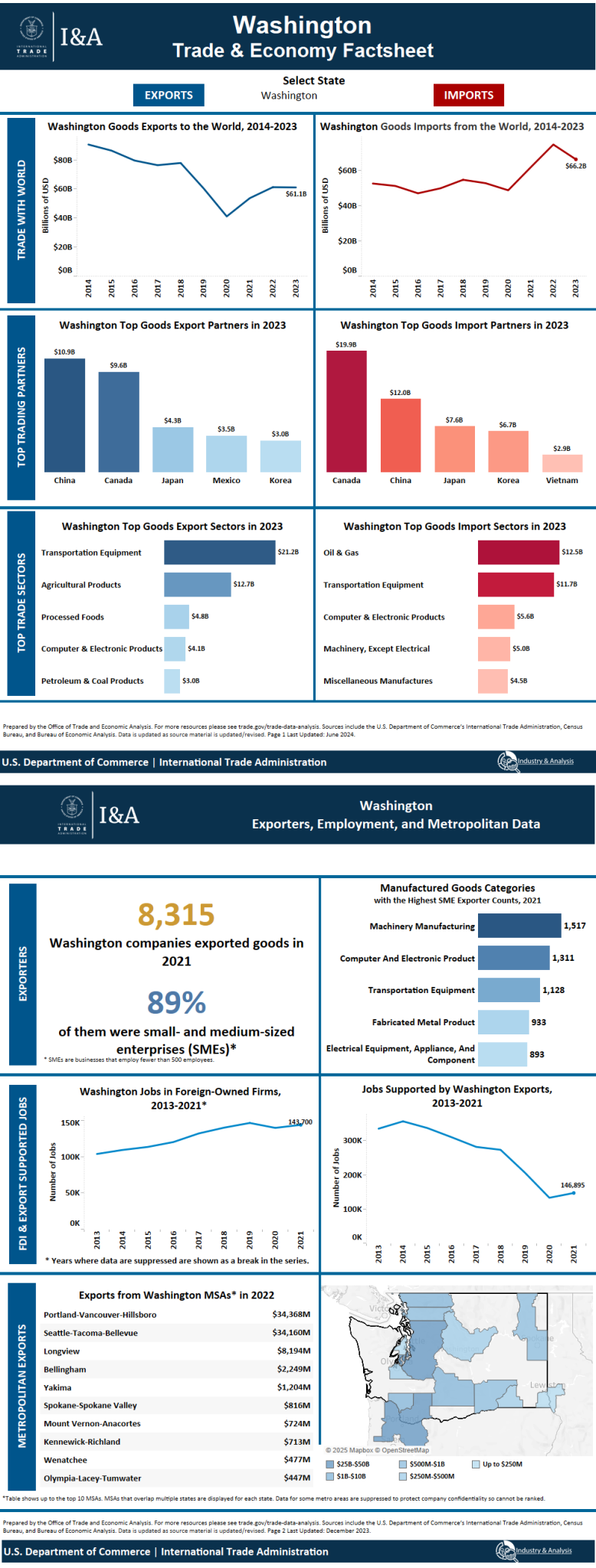
Washington State is one of the most trade-dependent states in the U.S., with nearly one-third of jobs tied to international trade. The tariffs and retaliatory measures will likely have far-reaching effects on maritime commerce, including:

✔️ Higher costs for Washington importers, particularly in retail, electronics, and construction materials.
✔️ Disruptions to key agricultural exports, including apples, cherries, seafood, and dairy, which rely on Canada, Mexico, and China as major markets.
✔️ Slower container traffic at the Northwest Seaport Alliance (NWSA), which already faces challenges from shifting global trade routes and supply chain disruptions.
✔️ Increased operational uncertainty for shipping companies, freight forwarders, and terminal operators, as businesses re-evaluate sourcing and trade strategies.

What’s Next?

The executive orders authorizing these tariffs include provisions for further increases should Canada, Mexico, or China introduce additional retaliatory measures. Given the strategic importance of international trade to Washington State, the Marine Exchange of Puget Sound will continue to monitor developments and coordinate with industry stakeholders to assess potential impacts.

With additional uncertainties such as the ongoing Red Sea crisis and global shipping disruptions, Washington’s maritime industry must remain agile and prepared for shifts in trade patterns.

The Marine Exchange will provide ongoing updates and encourages stakeholders to remain engaged as these policies unfold.

The Path Forward: Uncertainty and Opportunity

Despite these challenges, Washington has a strong tradition of trade leadership and economic adaptability. Our maritime industry, ports, and businesses must:

  • Engage with policymakers to advocate for trade policies that protect Washington’s economic interests. I’ll be in Olympia tomorrow to testify on HB 1689, which proposes fully adopting California Air Resource Board (CARB) standards for ocean-going vessels at berth here in Washington.
  • Diversify markets and trade routes to reduce reliance on any single country or region. If we are to leverage our maritime industry as a means of diversification, we can’t afford to lose more industrial capacity. The Marine Exchange has opposed the City of Seattle’s proposed rezoning of maritime industrial lands and is engaged with the Seattle City Council.
  • Leverage maritime innovation to remain competitive in an increasingly complex trade environment. We’re launching an online career development center this year and bringing back the monthly agent/ops meeting that went away during COVID. Now is a time to double down on community and cooperation.

For further information, please contact us.

Hold Fast.